
Wear Rings & Why They Matter
Wear rings are sacrificial components that are designed to support the moving piece of hardware and keep the piston from hitting the inside of the cylinder over and over again. They help prevent metal-on-metal contact and provide the piston or rod seal with guidance and support. At T-Lon Products, our TMWR and TIWR wear rings are precision machined of rigid PTFE material and come in four different cut styles. Dive into the importance of wear rings and why they matter for the efficiency and longevity of your machines.
Wear Rings & Why They Matter
What are wear rings?
When you think wear ring, think sacrifice. They are the parts that are sacrificed to protect other, more valuable parts. Wear rings absorb the forces between a piston or rod in hydraulic/pneumatic cylinders, valves, manifolds, motors and systems so that there’s no metal-to-metal contact between them.
Wear rings feature an intentional gap, or cut, in the ring. The gap allows fluid to flow to and from the seal gland and prevent pressure trap or hydrolock between the seal and wear ring. If there’s a chance that the cut ends of the wear ring may touch (usually due to the high thermal expansion of PTFE), a radius groove can be added to both ends of the ring. The groove will allow fluid to continue flowing even if the ends are touching.

Wear rings can also be paired with a spring in what is called a “spring energized wear ring.” Adding the spring helps support the weight of the piston or rod evenly. The spring also helps compensate for wear.
Can wear rings be cut in different ways?
Yes, wear rings can be cut in a couple different manners, and the method of cut provides additional features. The most common cut is an angle (or scarf) cut, but wear rings can also be ordered with a butt, step, or zee cut.
About the Angle / Scarf Cut
The angle or scarf cut supports a radial load with end overlap.
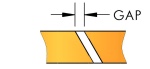
About the Butt Cut
The butt cut is the most economical of the cuts and is straight up and down.
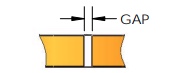
About the Step Cut
The step cut features the same sized gap as the angle and butt cuts but with an obstructed leak path. Like the angle cut, the step cut supports radial load with end overlap.
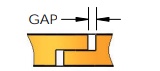
About the Zee Cut
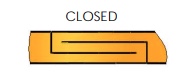
This cut is named for the shape it makes – a “z.” It expands and contracts without a through cut, so there is no direct leak path.
Why is a wear ring important?
They are low friction. They improve efficiency and the concentricity of a cylinder. They reduce long-term expenses by absorbing abrasion, which helps to protect the more expensive and critical components. Wear rings also prevent galling (that’s when metal surfaces fuse together because of heavy pressure and friction). They prevent too large of extrusion gaps, which can cause seal failure.
When it comes to spring energized wear rings, they contribute additional benefits like:
- reducing bear load,
- reducing cylinder scoring,
- compensating for wear,
- supporting piston weight, and
- minimizing eccentric condition.
Additionally, wear rings are much cheaper to replace than the component itself. Wear rings help the component to operate at peak performance for longer.
Because of their importance, wear rings should be checked regularly for signs of damage and replaced when erosion occurs.
What applications use wear rings?
Wear rings are found in many places, as they can be used in both dry and lubricated applications. They can be found in:
- Shocks and structs
- Mobile hydraulic cylinders
- Pneumatic piston cylinders
- Agriculture equipment
- Hydraulic valves and pumps
- Filling machines
- Testing machinery
T-LON’s Wear Rings
As mentioned earlier, T-LON’s wear rings are precision engineered from PTFE. T-LON offers the TMWR Series Metric rings and the TIWR Series Inch rings.
About the TMWR Series
T-LON’s TMWR series is made from a PTFE compound. The compound and width of the ring determine the allowable radial load and velocity ranges. The velocity can be up to 15 m/s with the TMWR, and the temperature range is -240 degrees Celsius to 285 degrees Celsius. Some of the most common TMWR series rings are car/graphite filled PTFE, bronze filled PTFE, and glass/MoS2 filled PTFE.
Car/graphite filled PTFE features:
- High compressive strength/wear resistance.
- Chemical resistant and used in applications with minimal to no lubrication.
Bronze filled PTFE features:
- Like the car/graphite filled, bronze filled also has high compressive strength and wear resistance. The more bronze content in the wear ring, the better these qualities are.
- Bronze also has low abrasive features.
Glass/MoS2 filled PTFE features:
- Good wear resistance for parts with rougher surface finish.
- Chemical resistant and used in applications with minimal to no lubrication.
About the TIWR Series
The TIWR series wear rings are similar to the TMWR, but with specifications customized for the imperial system. Like the TMWR, TIWR is made from a PTFE compound which, along with width, determines the allowable radial load and velocity ranges. Velocity can be up to 50 ft/sec with this series, and the temperature range is from -400 degrees Fahrenheit to 500 degrees Fahrenheit.
The most common versions of the TIWR series are bronze filled PTFE and glass/MoS2 filled PTFE. The same features apply here as in the TMWR:
Bronze filled PTFE features:
- High compressive strength and wear resistance. The more bronze content in the wear ring, the better these qualities are.
- Low abrasive features.
Glass/MoS2 filled PTFE features:
- Good wear resistance for parts with rougher surface finish.
- Chemical resistant and used in applications with minimal to no lubrication.
About T-LON
Family-owned and operated for 45 years, serving all five continents, T-Lon has combined a progressive customer-centered approach with a no-nonsense financially-sound philosophy to achieve consistent growth and steady customer satisfaction.
This philosophy has allowed T-Lon to position itself for the long-term and continue its tradition of service, quality, and pricing. If you’re looking for reliable, high-performance wear rings for your equipment, get in touch with us today to learn more about our sealing solutions.
We want to be your preferred PTFE parts Supplier and Partner.