
TIWR Series Inch Wear Rings
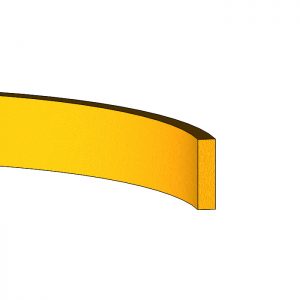 The TIWR wear rings are precision machined to guide a rod or piston to avoid metal on metal contact in dry and lubricated applications. A gap is intentionally added to the wear ring to allow fluid flow to and from the seal gland and prevent pressure trap or hydrolock between the seal and wear ring. In the case where the cut ends of the ring touch due to the high thermal expansion of PTFE, an optional radius groove is added on both ends to continue to allow fluid flow.
The standard cut is an angle (scarf) cut, but TIWR wear rings can be ordered with a butt, step, or zee cut. An angle or scarf cut supports the radial load with end overlap, while the butt cut is the most economical. A step cut supports the radial load with end overlap and has an obstructed leak path. Zee cuts expand and contract with no through cut and no direct leak path.
Advantages of the TIWR Series Inch Wear Rings:
- Low Friction
- Improve Concentricity
- Prevent large extrusion gaps that cause seal failure
- Prevent Galling
Applications of the TIWR Series Inch Wear Rings:
- Shocks and Struts
- Mobile Hydraulic Cylinders
- Pneumatic Piston Cylinders
- Agriculture Equipment
- Hydraulic Valves and Pumps
- Filling Machines
- Testing Machinery
Technical Data:
The T-LON® PTFE wear ring compound and width determines allowable radial load and velocity ranges
- Velocity: Up to 50 ft/s
- Radial Load: See Calculation (Max velocity and radial load cannot be used together)
- Temp. Range: -400°F to 550°F (Above 250°F, compressive strength decreases reducing radial load capability)
Most Common:
BRONZE FILLED PTFE (“21” or “22”)
- High compressive strength/wear resistance (More bronze content improves these properties).
- Low abrasive features
GLASS/MoS2 FILLED PTFE (“31”)
- Good wear resistance for parts with rougher surface finish
- More chemical resistant and used in applications with minimal to no T-LON MAT’L lubrication
Calculating Ring Width using Bearing Stress Calculation:
Width (in) = (F x FS) / (ID x C)
- F = Radial Force (lb)
- FS = Factor of Safety (2 Min. recommended)
- ID = Rod Diameter / Assembled Ring ID (in)
- C = Wear Ring Compressive Strength (psi, See Table 1)