
What is a buffer seal? Buffer Seal FAQs
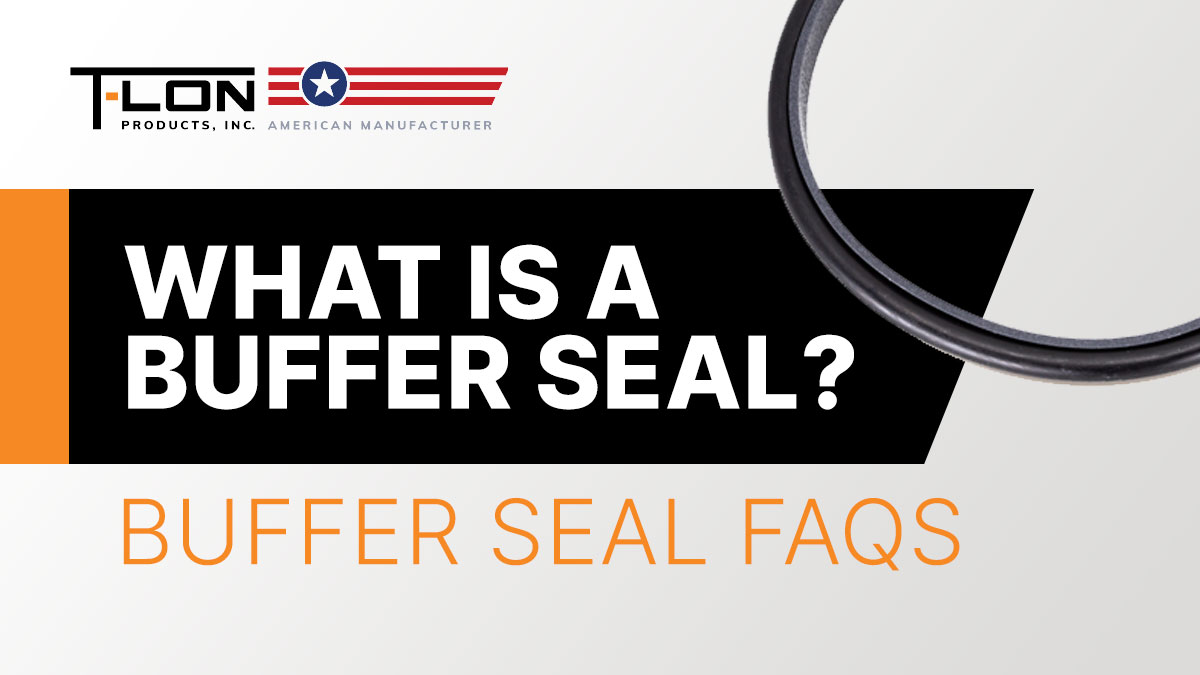
Hydraulic systems depend on precision, durability, and protection against extreme operating conditions, and all of this is typically provided by the main seal. What protections, then, does the main seal have? Here’s where the buffer seal comes in. Buffer seals play an important role as the first line of defense. They protect against pressure spikes and ensure smooth, reliable operation. These seals are often an afterthought, but they’re critical for long-lasting performance, especially in extreme environments.
Learn more about buffer seals and why they matter, and then explore the buffer seal products that T-LON offers. From extending equipment life, to reducing downtime, to optimizing overall system efficiencies, buffer seals make a significant impact, and especially in environments with frequent sudden surges and constant motion.
Buffer Seal FAQs
What is a buffer seal?
Also known as an auxiliary rod seal, a buffer seal is a hydraulic sealing element that maintains contact between the cylinder head and piston rod during reciprocation. It is typically a uni-directional seal that works in tandem with a secondary rod seal to absorb sudden pressure spikes, protecting the primary seal and piston rod when system pressure surges.
Beyond sealing, buffer seals enable controlled fluid management. They allow a small, metered amount of fluid to pass to the secondary rod seal, which then traps it—allowing the buffer seal to pump the fluid back into the system on the return stroke. This helps maintain lubrication and prevents the main seal from deformation, tearing, or leaking.
Why is a buffer seal important?
The primary function of a buffer seal is to handle pressure spikes and protect the main seal, extending system life and performance. Buffer seals are essential for:
- Pressure Spike Protection: Absorbs surges to protect the main seal from damage.
- Leak Prevention: Minimizes internal leakage and fluid contamination while maintaining proper lubrication.
- Smooth Operation: Reduces friction and wear for smoother motion and extended component life.
- Enhanced Performance: Improves reliability and efficiency across the entire rod sealing system.
What are common applications of buffer seals?
Buffer seals are ideal for heavy-duty hydraulic systems such as:
- Construction and agricultural equipment
- Injection molding machinery
- Industrial and mobile hydraulic cylinders
- Shock absorbers and hydraulic hammers
These systems commonly experience sudden pressure surges and are nearly always in motion, making them an ideal setting for buffer seals. With buffer seals in place in these extreme conditions, the main seal is protected and is less likely to tear or leak.
T-LON’s Buffer Seals
T-LON Products offers three models of rod buffer seals, all of which have at least ten years of proven success in the field: the SRI Series Stepped Rod Buffer Seal, the SRM Series Stepped Rod Buffer Seal, and the CB Series Stepped Rod Buffer Seal. T-LON’s buffer seals minimize energy loss by providing low seal drag or friction. They ensure smooth operation with no stick-slip. The buffer seals from T-LON have a long life due to T-LON’s filled PTFE compounds. T-LON’s seals are available for rods up to 44″ in diameter.
About the SRI Series Stepped Rod Buffer Seal
The SRI stepped rod buffer seal has over 30 years of application success and is a proven reliable seal for both low and high pressure systems. The SRI seal is a single-acting filled TLON® PTFE compound with an o-ring elastomer energizer designed for reciprocating applications. The filled PTFE seal ring is manufactured with an interference fit with the rod and optimum compression with the o-ring energizer. The single-acting seal design must be asssembled with the step facing the media to be sealed. The optimized lip profile removes the fluid film during rod extension and allows fluid return during rod retraction. To prevent seal damage during extreme pressure spikes, the stepped profile allows temporary leakage that is sealed by a secondary buffer seal to prevent fluid into the environment.
The T-LON® seal compound determines allowable pressure and velocity ranges:
- Velocity: Up to 13 ft/s
- Pressure: Up to 8500 psi
(Function of e-gap and T-LON® compound. Max velocity and pressure cannot be used together)
The Loader compound determines temperature and chemical compatibility. See the full spec sheet here.
About the SRM Series Stepped Rod Buffer Seal
The SRM Series Stepped Rod Buffer seal also has over 30 years of success in the field. It is similar to the SRI Series Stepped Rod Buffer Seal in all things, but allows for different allowable pressure and velocity ranges:
- Velocity: Up to 4 m/s
- Pressure: Up to 60MPa
Again, the Loader compound determines temperature and chemical compatibility. See the full spec sheet here.
With over 30 years of application Success, the SRM stepped rod buffer seal is a proven reliable seal for both low and high pressure systems.
About the CB Series Stepped Rod Buffer Seal
This seal is specifically intended for the Caterpillar Type B buffer seal grove. T-LON has supplied this stepped rod buffer seal for use in Caterpillar® Hydraulic Cylinders for over ten years. While this seal is also a single-acting filled TLON® PTFE compound, the CB Series features a custom designed rectangular profile elastomer energizer. The filled PTFE seal ring is manufactured with an interference fit with the rod and optimum compression with the O-ring energizer. The single-acting seal design must be assembled with the step facing the media to be sealed. The optimized lip profile removes the fluid film during rod extension and allows fluid return during rod retraction. To prevent seal damage during extreme pressure spikes, the stepped profile allows temporary leakage that is sealed by a secondary buffer seal to prevent fluid into the environment. Its technical data is as follows:
T-LON® seal compound determines allowable pressure and velocity ranges:
- Velocity: Up to 13 ft/s
- Pressure: Up to 8500 psi
(Function of e-gap and T-LON® compound. Max velocity and pressure cannot be used together.)
About T-LON
Family-owned and operated for 45 years, serving all five continents, T-Lon has combined a progressive customer-centered approach with a no-nonsense financially-sound philosophy to achieve consistent growth and steady customer satisfaction.
This philosophy has allowed T-Lon to position itself for the long-term and continue its tradition of service, quality, and pricing. If you’re looking for reliable, high-performance buffer seals for your equipment, get in touch with us today to learn more about our sealing solutions.